

Photovoltaic Installations. Cables and panels interconnection.
A decade ago, photovoltaic (PV) systems – whether for residential use or large-scale solar farms generating electricity – were a novelty in our surroundings. Today, we are accustomed to seeing solar panels on the roofs of single-family homes, government buildings like city halls and schools, and even vast solar farms covering several hectares. But what exactly is a home photovoltaic system, and how does it differ from an industrial solar farm? The answer can be summed up in one word – scale. Both systems use the same components; the differences lie in the number of elements (solar panels), the power capacity of devices (inverters), and the type of cables used (with larger cross-sections allowing for greater power transmission).
The structure of a photovoltaic system can be presented as follows:
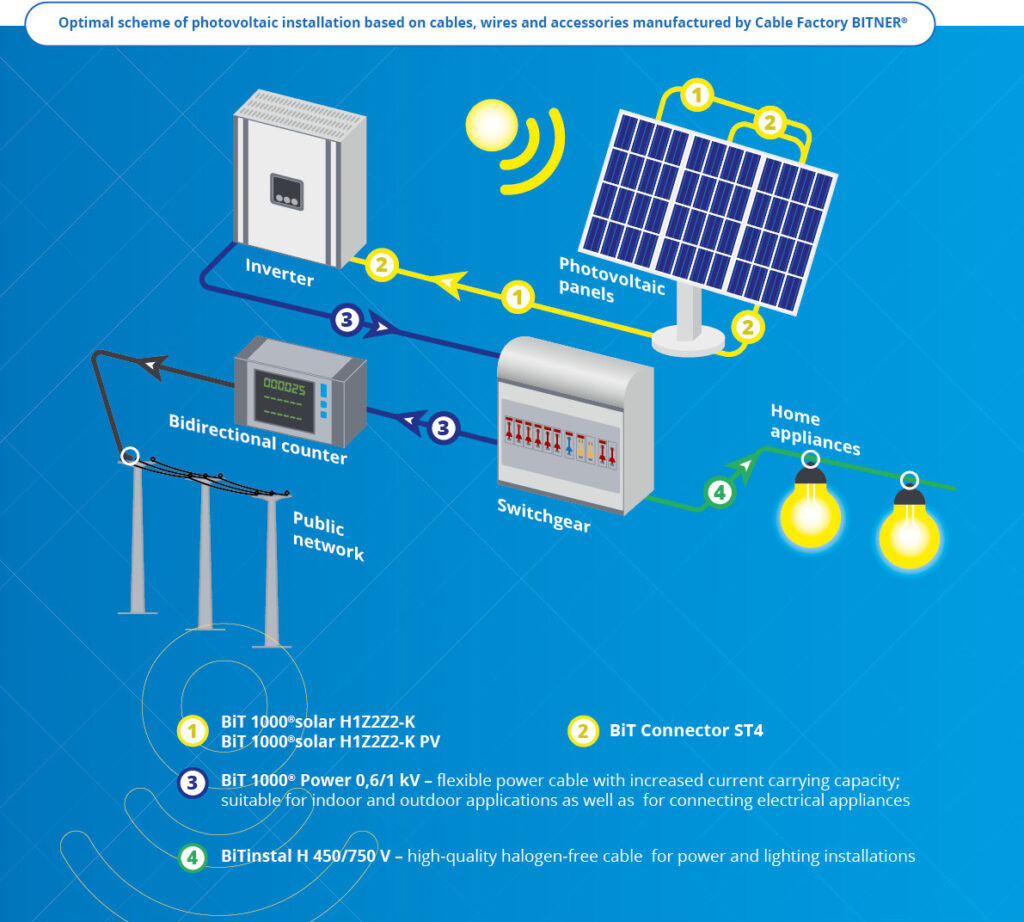
- Photovoltaic panels are connected in series with cables to form sections for DC power generation, and the produced energy is transmitted via cables to the inverter. For this part of the installation, ideal cable options include BiT 1000® solar, BiT 1000® solar PV, BiT 1000® solar H1Z2Z2-K, or BiT 1000® solar H1Z2Z2-K PV. The cables are connected to the photovoltaic panels using ST4 connectors. All the cables mentioned are halogen-free and flame-retardant, which is especially important for indoor installations. The BiT 1000® solar and BiT 1000® solar PV cables, thanks to their materials and construction in accordance with EN 50618 and IEC 62930 standards, are suitable for wiring any type of photovoltaic system. For international projects requiring TÜV certification, the BiT 1000® solar H1Z2Z2-K cables are recommended.
- The inverter converts the received DC power into AC power, which is then delivered to the distribution unit using BiT 1000® Power or BiT 1000®H Power cables. These cables are highly flexible, facilitating easy installation; they are UV-resistant, weather-resistant, and suitable for direct burial in the ground.
- To meet the high fire protection standards required – for example, in public buildings—BiTinstal® H(p) cables are recommended for powering receivers. These halogen-free installation cables are rated for operating voltages up to 750V and can also be installed under plaster.
For detailed technical specifications on cables for the entire photovoltaic system, please refer to the respective technical datasheets.

Knowledge base

How to Select a Servo Cable for a Motor? The most important aspects
Frequency converters play a crucial role in various...
Read
Fiber Optic Cables – Types and Symbol Meanings. Key aspects
Fiber optic cables are essential for transmitting data ...
Read
Laying Cables in the Ground According to N-SEP-E-004
Guidelines for laying electric cables in the ground
Read