

Fiber Optic Cables – efficient methods of data transmission
Fiber optic cables, which gained popularity at the end of the last century, remain among the most advanced and efficient methods of data transmission.
The key component of these cables is the optical fiber itself. Inside the fiber, information is transmitted through a modulated light wave, which is resistant to interference from magnetic fields. This light wave is generated by either a semiconductor laser or a light-emitting diode (LED), while a light-sensitive device, such as a photodiode, is used to receive the signal.
Optical fibers not only resist external electromagnetic interference but also maintain an error rate below 10⁻¹⁰ at maximum data rates, with low attenuation—approximately 0.20 dB/km at a wavelength of 1550 nm in single-mode fibers.
The core of an optical fiber is made from a special type of quartz glass, surrounded by cladding and a protective layer.
The functioning of an optical fiber relies on the properties of two materials with different refractive indices, with the core having a higher refractive index than the cladding. This difference results in total internal reflection, causing the light ray to reflect off the boundary between the core and cladding, allowing it to travel continuously within the core. The cladding is further protected by a primary coating.
Types of Optical Fibers Used in Telecommunications
Single-Mode Fiber (SMF)
Single-mode fibers have a very narrow core, approximately 9 µm in diameter, which allows light to travel along a single path. This design minimizes dispersion and signal delay, enabling data transmission over distances of several hundred kilometers without requiring signal amplification.
- Applications:
- Intercontinental and intercity connections
- Backbone networks for telecommunications providers
- 5G infrastructure
- Advantages
- High bandwidth with minimal interference
- Excellent signal stability over long distances
Multi-Mode Fiber (MMF)
Multi-mode fibers have a larger core (50–62.5 µm), allowing light to travel along multiple paths simultaneously. As a result, they are typically used for shorter distances, such as within buildings or campuses, where high data transmission speeds are required, but the range is limited.
- Applications:
- Local area networks (LANs)
- Data centers
- In-building connections
- Advantages:
- Lower installation and equipment costs
- High transmission speeds over short distances
Optical transmission offers a significant advantage in terms of bandwidth. One of the key strengths of fiber optics is its ability to transmit large amounts of data simultaneously.
- For single-mode fibers:
- Bandwidth typically ranges from 10 Gb/s to 400 Gb/s per channel.
- By employing multiplexing techniques such as DWDM (Dense Wavelength Division Multiplexing), it is possible to achieve bandwidths in the terabit-per-second range. DWDM allows multiple signals to be transmitted at different wavelengths within a single fiber.
- For multi-mode fibers:
- Bandwidth ranges from 10 Gb/s to 100 Gb/s, depending on the specific standard (e.g., OM3, OM4, OM5).
- Multi-mode fibers generally have lower range and speed compared to single-mode fibers, as the presence of multiple light modes can lead to signal dispersion over longer distance
All optical fibers, regardless of type, share common characteristics, including low mechanical strength and sensitivity to environmental factors, particularly moisture. To protect the fibers, a secondary coating is applied in the form of a tube.
There are various types of tubes: Tight tubes, Semi-tight tubes, Loose tubes
These tubes, which house the fibers, can be arranged into cable cores. Once reinforced and appropriately sheathed, they become fiber optic cables.
Depending on their application, fiber optic cables are classified into two main types:
- External cables: Designed for outdoor use, whether overhead or underground, these cables feature protective reinforcements and a sheath that withstands sunlight and moisture.
- Internal cables: Specifically designed for indoor installations, these cables adhere to stringent safety standards and are covered with a flame-retardant, halogen-free plastic sheath.
Examples of fiber optic cables include the BiTfiber series, which are categorized as follows:
- Outdoor cables (e.g., BiTfiber Z XOTKtmsd, BiTfiber S XOTKtsdp) – designed to withstand all weather conditions.
- Universal cables (e.g., BiTfiber ZW NOTKtsd, BiTfiber U DQ(ZN)BH) – suitable for various applications.
- Indoor cables (e.g., BiTfiber W-NOTKSd (simplex), BiTfiber W-NOTKSd (minibreakout)) – featuring a unique design that enhances fire safety, minimizes flammability, and reduces toxic gas emissions during a fire.
- Special-purpose cables (e.g., BiTfiber ZKS-XXOTKtsFo, BiTfiber YOTKGtsDFoyn) – designed for environments with specific hazards, such as mining or wastewater systems.
Applications of Fiber Optic Cables
- Telecommunications and Internet Fiber optic cables form the backbone of modern telecommunication networks, enabling high-speed data transfer both internationally and locally. They are widely used in broadband networks, 5G systems, and transoceanic connections.
- Energy and Industry
- Fiber optics are utilized to monitor power grid performance and transmit control signals in industrial automation. In the energy sector, they enable rapid data transmission on network status, allowing for early fault detection.
- Multimedia An increasing number of multimedia platforms, such as video streaming and online gaming, rely on fiber optics to deliver high-quality content with minimal latency.
The Future of Fiber Optic Technology
Fiber optic cables are essential for the advancement of future infrastructure. With the rise of applications such as the Internet of Things (IoT), real-time streaming, and artificial intelligence (AI), the demand for faster and more reliable connections continues to grow—something that fiber optics can effectively provide. As 5G networks expand and internet access improves in rural and remote areas, the importance of fiber optics will only continue to increase.
Summary
Fiber optic cables serve as the backbone of modern data transmission systems, enabling fast, secure, and reliable long-distance communication. Their increasing use in sectors such as telecommunications, healthcare, energy, and industry has made them a crucial component of global infrastructure. While the implementation of fiber optic technology requires investment, the benefits it provides make it the optimal solution for the demands of today’s world.

Knowledge base

How to Select a Servo Cable for a Motor? The most important aspects
Frequency converters play a crucial role in various...
Read
Photovoltaic Installations. Cables and panels interconnection.
A decade ago, photovoltaic (PV) systems...
Read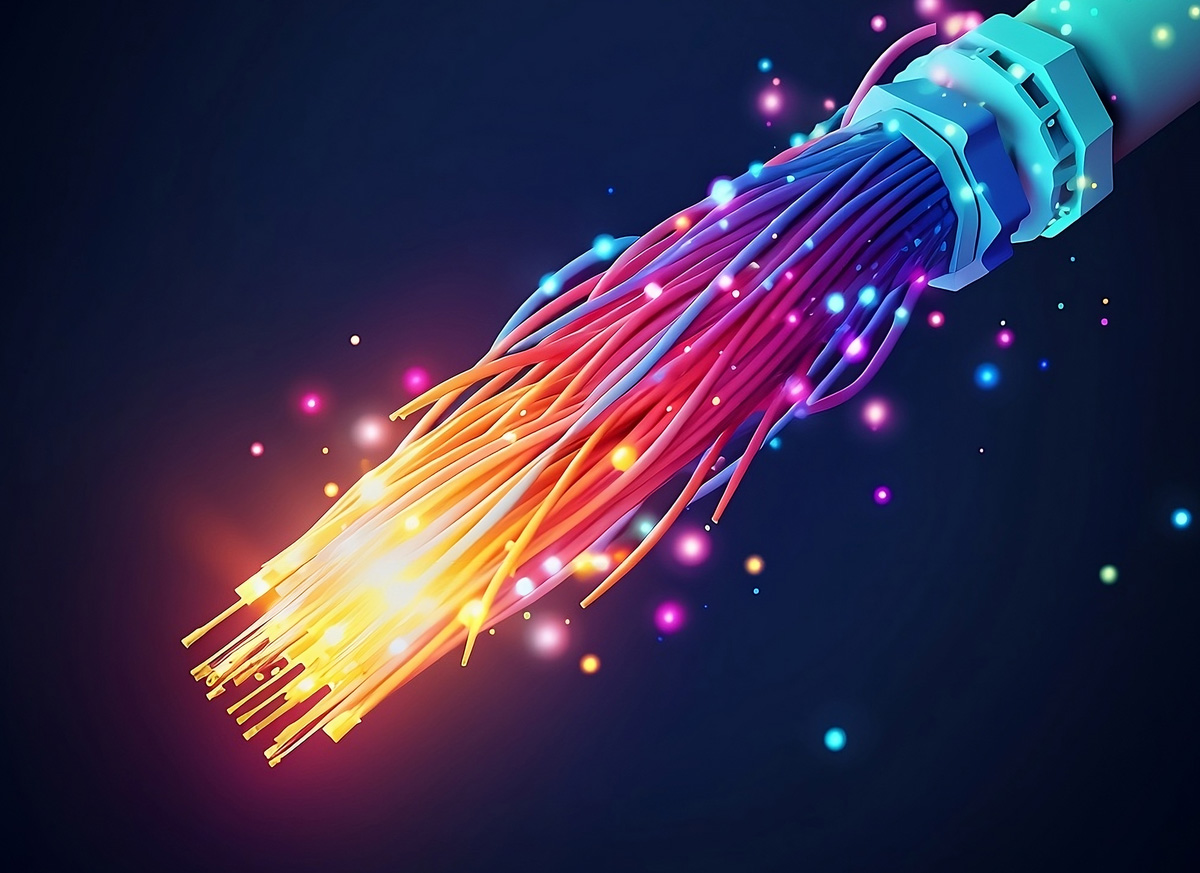
Fiber Optic Cables – Types and Symbol Meanings. Key aspects
Fiber optic cables are essential for transmitting data ...
Read